Borobudur: An Initiation in Stone
Overview
Borobudur Is Not a Monument. It Is a Curriculum.
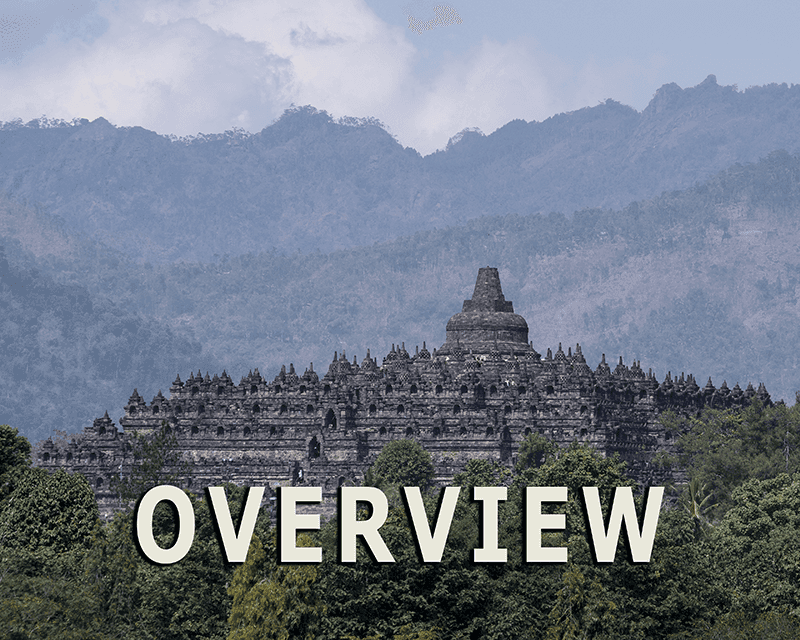
Most visitors see Borobudur as a temple, perhaps the largest Buddhist temple in the world, and leave it at that. But Borobudur was never meant to be admired from the outside. It is a complete Buddhist education system built in stone — a graduated path from the most basic human condition to the highest state of awakening, organized as a physical structure you walk through from bottom to top.
Every level contains a different body of teaching. The sequence is deliberate. Nothing is decorative. Every panel, every gallery, every terrace is a stage in one continuous journey — and that journey has a destination.
The Hidden Base: Karmavibhanga
The lowest level of Borobudur is buried.
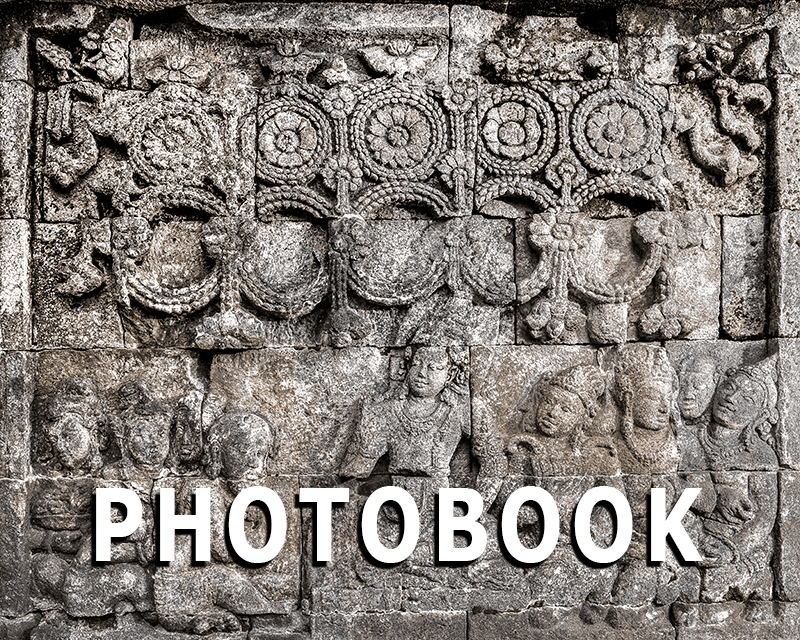
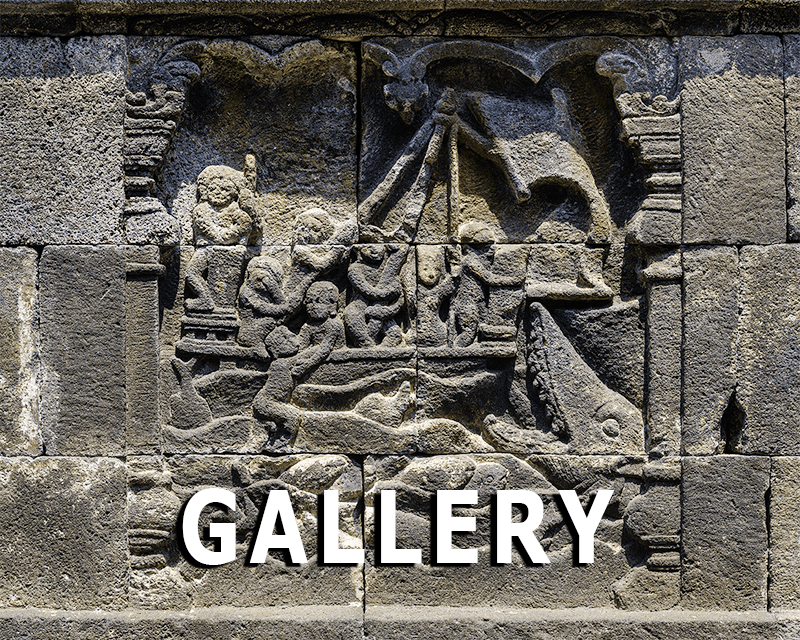
These 160 panels illustrate the Karmavibhanga — the law of cause and effect. Every action produces a consequence. Generosity, cruelty, honesty, deceit — each is shown alongside its result, across this life and beyond. The carvings are explicit, sometimes brutal. They show humans, animals, hungry ghosts, hell realms. The full range of existence driven by action and its fruit.
Why they are buried remains one of Borobudur’s open questions. Two serious explanations exist, and neither has been conclusively settled.
The first is structural: the original base may have been shifting under the monument’s immense weight. The added encasing wall — which buried the Karmavibhanga — stabilized the foundation and prevented collapse. Under this reading, the concealment was engineering, not theology.
The second is intentional: the Karmavibhanga panels depict hell realms, sexual misconduct, torture, and extreme suffering — imagery that may have been deemed inappropriate for open public viewing, or deliberately reserved for initiates who understood their doctrinal context. The burial becomes an act of esoteric architecture: the foundation of the path is present, it holds everything above it, but it is not displayed.
Both explanations may be true simultaneously. A structural necessity and a theological appropriateness can coincide — and the architects may have recognized in that coincidence an opportunity to give the engineering decision a deeper meaning.
What is not in dispute: the Karmavibhanga is foundational in both senses. Structurally, it is what Borobudur physically rests on. Doctrinally, karma — the recognition that every action produces consequence — is what every Buddhist path rests on. You do not study the ground you stand on. You stand on it. Whether the burial was forced or chosen, the result is the same: the entire monument rises from a hidden teaching about the nature of cause and effect.
The Wide Lower Galleries: Jataka and Avadana
The widest, most expansive galleries of Borobudur are covered with hundreds of narrative panels showing the previous lives of the Buddha and other great beings.
The Jataka tales show Shakyamuni Buddha across hundreds of past lives — as a king, a merchant, an animal, a laborer — always practicing the same virtues: generosity (dana), moral discipline (sila), patience, effort, and wisdom. Life after life, through joy and suffering, building the character required to become a Buddha.
The Avadana stories extend this to other great beings whose acts of devotion and compassion created the conditions for liberation.
The sheer number of panels communicates something important: this takes an immense amount of time. There is no shortcut past this level. The cultivation of virtue is not preparation for the real practice — it is practice. The path cannot be entered from above. It must be walked from here.
In the language of Buddhist teaching, this is the accumulation of paramita — the perfections that form the character of a Bodhisattva. Borobudur places this accumulation in its largest architectural space because it receives the largest portion of a practitioner’s life.
The First Ascending Gallery: Lalitavistara
Here the biography of Shakyamuni Buddha unfolds in 120 panels — from his decision to descend from Tushita heaven, through his birth, his renunciation of the palace, his years of practice, and his enlightenment under the Bodhi tree.
This is not simply a historical account. In Mahayana understanding, the historical Buddha is an emanation — a cosmic Buddha taking human form to demonstrate that the path from ordinary existence to full awakening can be walked. The cosmic light took human shape, walked every step of the path, and reached the summit.
The Lalitavistara sits at the hinge of the entire structure. Below it: the accumulation of virtue across countless lives. Above it: the interior journey of realization. Shakyamuni’s life is the bridge — the proof that the path is real, that the destination is reachable, and that every life lived below contributed to this moment of emergence.
The Upper Galleries: Gandavyuha
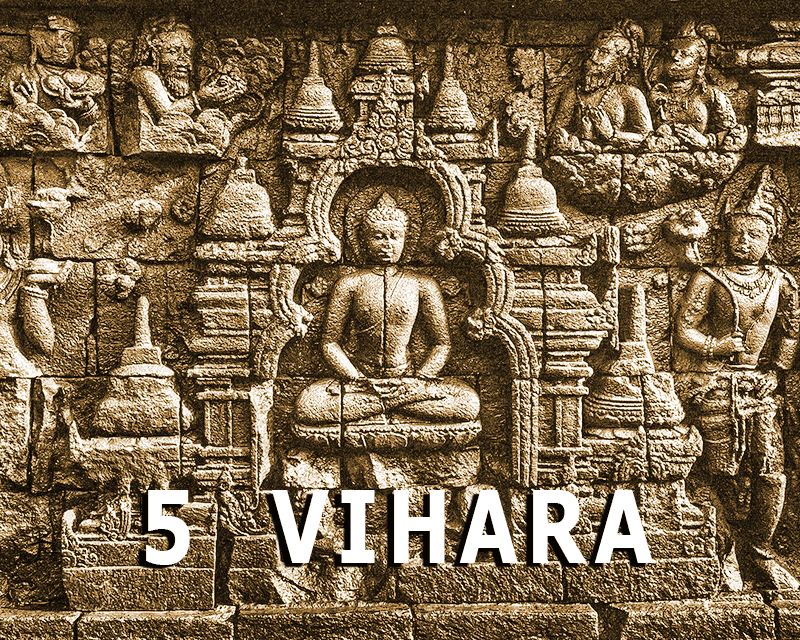
The uppermost narrative galleries depict one of the most remarkable stories in all of Buddhist literature: the Gandavyuha, the final and greatest chapter of the Avatamsaka Sutra — the Flower Garland Scripture. The Avatamsaka is the single most extensively represented text at Borobudur, occupying over 460 panels across the upper galleries.
A young seeker named Sudhana embarks on a pilgrimage to find wisdom. He visits 53 teachers — kings and beggars, monks and laypeople, bodhisattvas and housewives. Each teacher shows him one face of the totality of awakening. Each encounter opens his understanding further. He does not argue, compare, or debate. He receives. He sees. He moves on.
The journey culminates in his entry into the tower of the Bodhisattva Maitreya — a structure that contains within it infinite worlds, each containing infinite towers, each containing infinite worlds. The entire cosmos, reflected in and through every point within itself. This is Indra’s Net— the great Avatamsaka vision of reality as total interpenetration, where nothing exists in isolation, where every phenomenon contains and reflects every other.
Sudhana’s journey ends with the vow of Samantabhadra — the Bodhisattva of universal action — to serve all beings across infinite realms, across infinite time, with inexhaustible compassion.
The Gandavyuha is placed at the top of the narrative levels because it represents the highest truth that can be conveyed through story. Sudhana’s pilgrimage is the inner journey of every sincere practitioner — moving from teacher to teacher, opening layer by layer, until the separate self dissolves into the recognition of total interconnection.
At this level, narrative ends. What remains cannot be told. It can only be entered.
The Circular Terraces
Above the square galleries, Borobudur changes completely.
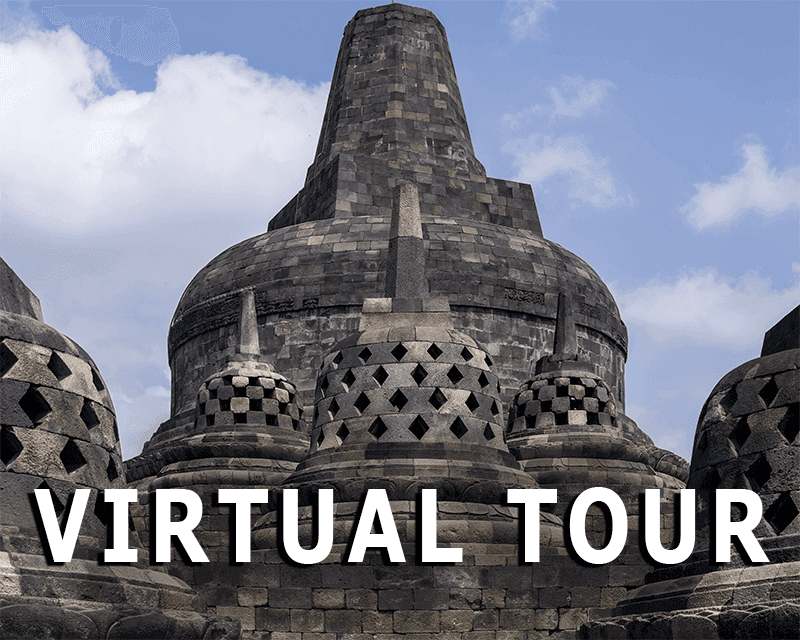
The walls disappear. The panels end. No more story, no more sequence of images. Three circular terraces open to the sky, holding 72 latticed stupas, each containing a seated Buddha visible only through the stone lattice — present but not fully graspable.
This shift is the most important architectural moment in the entire monument. For four levels, the pilgrim has been reading: panel after panel, story after story, life after life. Now the reading ends. There are no more words to follow, no more characters to identify, no more episodes to interpret. The square, with its corners and corridors and fixed orientations, gives way to the circle — a form without beginning, without end, without preferred direction.
The latticed stupas are intentional. The Buddhas inside are visible but not fully revealed. The degree of openness varies across the three terraces. The teaching is the structure itself: at this stage, the practitioner moves from conceptual learning to direct encounter, from form approached through narrative to form approached through space, silence, and presence.
Whatever the pilgrim has accumulated below — the recognition of karma, the reservoir of virtue, the example of a human Buddha, the visionary opening of the Gandavyuha — must now be carried upward without the support of further explanation. The terraces ask nothing more of the intellect. They ask only that the walker keep walking.
The Summit: Dharmadhatu
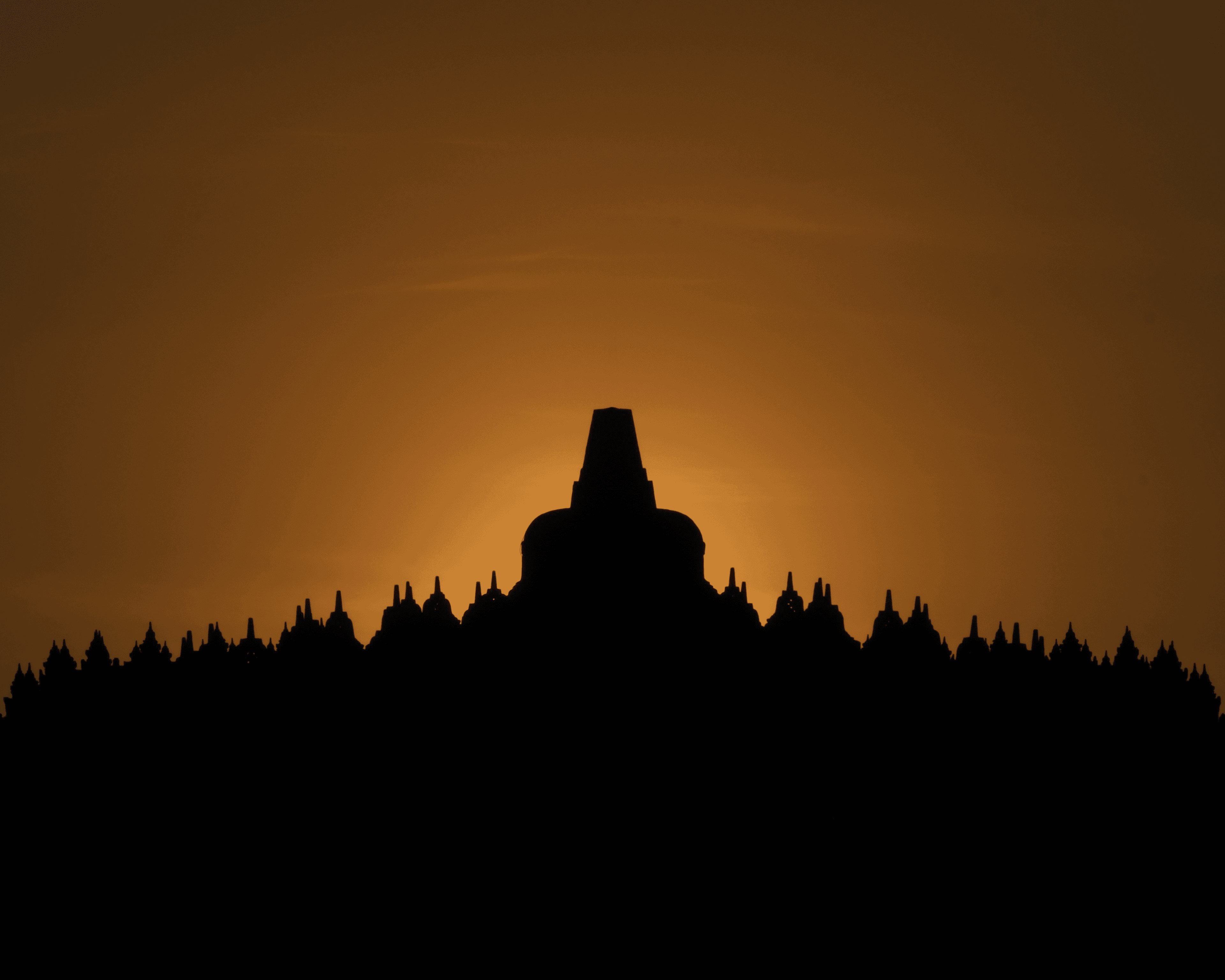
At the crown of Borobudur stands a single large stupa. When opened during restoration, it was found to contain an unfinished Buddha figure — with incomplete hands and asymmetrical proportions. Whether this statue was placed there as a deliberate symbol or discarded as a failed carving remains debated.
What is not debated is the architectural statement. The summit stupa is sealed, undecorated, and set apart from all the elaborate carving below. After 2,672 relief panels and 504 fully carved Buddhas, the monument ends in silence.
In the Avatamsaka vision that dominates Borobudur’s narrative program, the highest reality is the Dharmadhatu — the totality of all phenomena, the realm where all distinctions between self and other, form and emptiness, dissolve. The cosmic Buddha of the Avatamsaka tradition is understood as the Dharmakaya itself — formless, omnipresent, the luminous ground of all that exists. No image can adequately represent it. No carving can contain it.
An empty summit is not an absence. It is the only honest architectural expression of what lies beyond form, beyond story, beyond depiction. Every carving below was preparation for this silence. Every text, every story, every Bodhisattva figure led here — to the point where the monument’s teaching passes beyond the reach of stone.
Why Borobudur Stands Alone
Borobudur is not a collection of Buddhist stories displayed on walls. It is a single, complete initiation — a three-dimensional mandala-stupa you walk through, ascending from the recognition of karma through the cultivation of virtue, through the example of a human life, through the interior pilgrimage of the Gandavyuha, until you arrive, stripped of every conceptual support, at three circular terraces open to the sky, where the latticed Buddhas hold their silence and the final teaching is given not in words but in space.
What makes Borobudur unique is the way its narrative and architectural programs work together. The Avatamsaka Sutra — particularly its Gandavyuha chapter — provides the dominant narrative and philosophical content, occupying the largest portion of the monument’s relief program. The architecture itself, ascending from buried foundation through square galleries to circular terraces and a sealed summit, expresses what the texts cannot. No other Buddhist monument on earth integrates the vast Avatamsaka vision of cosmic interpenetration with this kind of walkable, ascending architectural progression.
Other monuments display Buddhism. Borobudur practices it. Other stupas enshrine relics. Borobudur enshrines a complete curriculum. Other temples are destinations. Borobudur is a journey.
The 8th-century Javanese architects who designed this structure understood something that took the rest of the Buddhist world centuries to articulate: that the highest teachings cannot be explained into someone. They must be walked into — stage by stage, text by text, silence by silence — until the walker and the path are no longer separate things.
That is what Borobudur is.
Explore My Borobudur Collections
This website hosts:
- 360° Virtual Tours and VR Experiences to immerse yourself in the monument’s grandeur.
- Complete Narrative Relief Panels—including reproductions of the finest photographs from around 1900, capturing the reliefs in their best condition, in PDF.
- Free Public Access to all images and materials, dedicated to Borobudur’s preservation.
- Podcasts explaining each level’s symbolism.
- References for further study and to honor scholarly contributions to Borobudur research.
Start your journey into Borobudur’s awe-inspiring world—experience its profound teachings, immerse in its grand design, and join us in preserving this priceless heritage for generations to come.
Published by: Lindra Hismanto
Medialoka is the definitive free archive of Borobudur. Its dual-layer photobook pairs all 1,300 visible relief panels with c.1900 archival reproductions, while an interactive 360° tour lets you explore every panel zoomable to 8K — browser-based and VR-headset compatible. Released under Creative Commons BY-NC.
FAQ
- What is Borobudur?
- Borobudur is a 9th-century Mahayana Buddhist temple located in Central Java, Indonesia. It is the largest Buddhist temple in the world and was designated a UNESCO World Heritage Site in 1991.
- Where is Borobudur located?
- Borobudur is located in Magelang Regency, Central Java, Indonesia, approximately 40 km northwest of Yogyakarta.
- How old is Borobudur?
- Borobudur was built during the 8th and 9th centuries under the Syailendra dynasty, making it over 1,200 years old.
- What are the relief panels of Borobudur?
- Borobudur features 2,672 individual relief panels carved into its stone walls. They depict Buddhist teachings, the life of Siddhartha Gautama, and stories from the Gandavyuha and Jataka sutras.
- Can I visit Borobudur virtually?
- Yes. Medialoka hosts a complete interactive 360° virtual tour of Borobudur, covering its relief galleries and stupa terraces. Every relief panel is clickable, captioned, and zoomable to 8K resolution. The tour is free, runs in any web browser, and is compatible with VR headsets.
- What makes the Medialoka Borobudur photobook unique?
- It is a free, dual-layer photobook covering all 1,300 visible relief panels. Each panel pairs original high-resolution medium-format photography with its c.1900 archival reproduction, side by side, with a short description. The 160 hidden Karmavibhanga base panels are preserved through their c.1900 plates. The complete A3 PDF is free to download under a Creative Commons BY-NC 4.0 license.
- Where can I find the 5 Buddhist Viharas near Borobudur?
- Medialoka publishes a Buddhist pilgrim guide to the five active Viharas around Borobudur: Vihara Mendut, Vihara Griya Vipassana Avalokitesvara, Bhante Win Meditation Center, Pusdiklat Catra Jinadhammo Training Center, and Vihara Graha Padmasambhava. Read the full guide at medialoka.com/articles/5-viharas.